
Asimov’s, May/June 2026
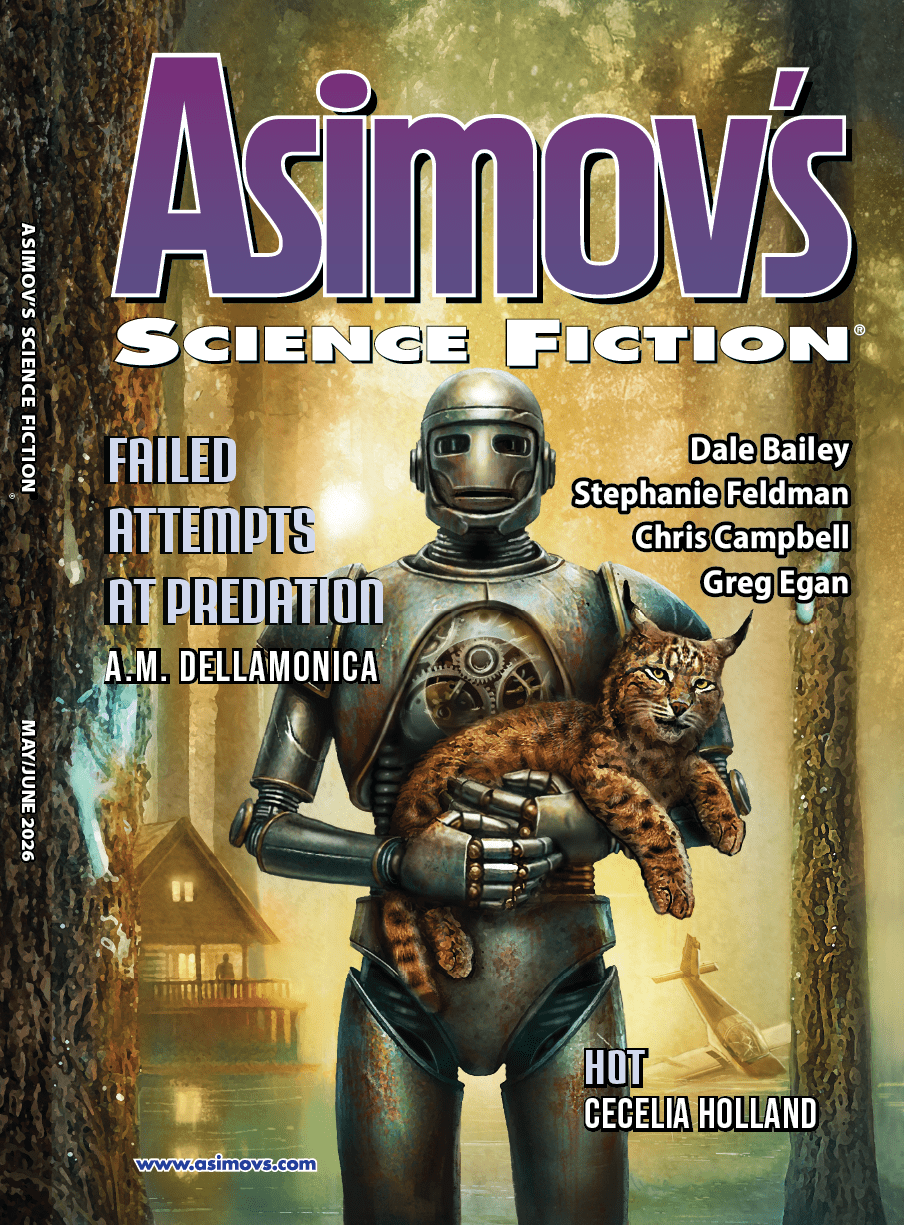
Elena, an entomologist at a Sydney university, wakes in the middle of the night in anaphylactic shock — swollen eyes, constricted throat, collapsing blood pressure. Her partner Daniel calls an ambulance, and paramedics stabilize her with epinephrine before taking her to hospital. There, Dr. Eggar delivers a diagnosis: Alpha-Gal Syndrome (AGS), an allergy to a carbohydrate molecule found on the cells of most mammals, triggered by a tick bite. The allergy means Elena can no longer eat red meat — beef, lamb, pork — though birds and fish remain safe. She processes the loss with characteristic pragmatism, and that evening Daniel prepares a Moroccan eggplant and chickpea stew that reminds her, almost inadvertently, how vast the culinary world still is.
A year later, AGS has become a global public health crisis. A visiting researcher, Dr. Linden, presents data showing a tenfold increase in cases worldwide, with the syndrome spreading beyond the known ranges of tick species traditionally associated with it. Elena, drawn by her personal experience and scientific curiosity, joins Linden’s lab. There she meets Sam, a vegan postdoc whose blood type B offers partial protection against sensitization, and she acclimates to a research environment that includes bandicoots — tick hosts immune to the paralysis toxin — kept in an outdoor enclosure.
Six months of meticulous study of Ixodes holocyclus, the paralysis tick, yields little. Its genome, anatomy, and range are largely stable. Meanwhile, the social landscape around AGS grows increasingly strange and volatile. Online, a weeping right-wing commentator dubbed the “Sad Professor” personifies the syndrome as a woman — “Alpha Gal” — whom he accuses of a feminist conspiracy to drain male vigor. Animal rights protesters in Spain ironically adopt the persona, wearing “Soy Alpha Gal” T-shirts at a piggery blockade, their shirts printed with CO₂-emissions data for various protein sources. Carnivore retaliation follows: a group calling itself “Alpha Heme” poisons tofu with strychnine in Italy. The culture war thickens around a molecule that doesn’t care.
Frustrated by institutional inertia, Elena applies for a position with a field research group in Adelaide, where AGS cases are proliferating with no Ixodes holocyclus present. She relocates for a year, conducting painstaking interviews and environmental sampling at patients’ homes and workplaces — people with no obvious tick exposure, living in apartments and concrete lots, far from bushland. The samples turn up beetles, ants, mites, mosquitoes — but no ticks, and no alpha-Gal antigen in the blood-feeders. Late one night, exhausted and scrolling through conspiracy theories, Elena comes across a thread speculating that soluble micro-needle patches, coated with alpha-Gal and pressed against strangers on crowded trains, could explain the outbreak. She cannot dismiss it.
Then her own throat begins to tighten — another reaction. She uses her EpiPen, and in the adrenaline clarity that follows, the real answer comes to her. The next morning she tests archived dust mite samples from all her patients. Under UV, a dissected mite’s gut fluoresces green: bacteria living inside common house mites are producing alpha-Gal, and mite detritus inhaled by humans is acting as an immune adjuvant, triggering the IgE response that causes AGS.
There is no Alpha Gal. There is no conspiracy. Nature has simply shifted in its sleep, as it did twenty-eight million years ago when a different alpha-Gal pathogen drove Old World primates to eliminate the molecule from their cells entirely. Elena concludes that fighting the ubiquitous mites and their bacteria will take decades and trillions of dollars. The simpler path — the one she has already been living — is adaptation.

Greg Egan specialises in hard science fiction stories with mathematical and quantum ontology themes, including the nature of consciousness. Other themes include genetics, simulated reality, posthumanism, mind transfer, sexuality, artificial intelligence, and the superiority of rational naturalism over religion.
He is a Hugo Award winner (and has been shortlisted for the Hugos three other times), and has also won the John W Campbell Memorial Award for Best Novel. Some of his earlier short stories feature strong elements of supernatural horror, while due to his more popular science fiction he is known within the genre for his tendency to deal with complex and highly technical material (including inventive new physics and epistemology) in an unapologetically thorough manner.
Egan is a famously reclusive author when it comes to public appearances, he doesn’t attend science fiction conventions, doesn’t sign books and there are no photos available of him on the web.