
Beneath Ceaseless Skies, March 2026
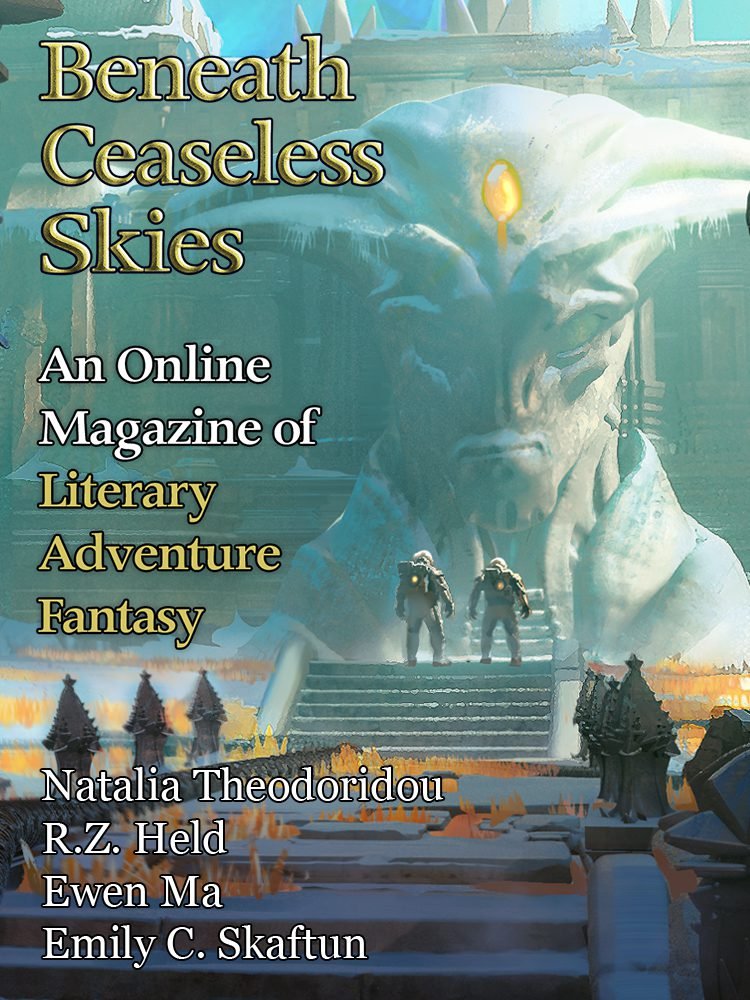
In the aftermath of a world-altering catastrophe called the Sundering—a cataclysm that swallowed cities into the sea and scattered families across the northlands—Sigrun, a young woman shaped by her grandmother’s bitter warnings about the heaven-born star-gods, yearns for a quiet life and a family of her own. Raised on tales of divine carelessness and mortal suffering, she has long hidden from the world, dreaming of peace yet fearing the future. A chance encounter with a shy farmer named Kristoff dissolves some of her fear, and the two marry, drawn together by their shared preference for comfortable silence over idle noise.
When months of trying for a child yield nothing, Sigrun hears of a witch in the half-ruined city of Vernisk who works wonders for women. Despite her grandmother’s warnings against entangling herself with heavenly magic, she seeks the witch out. She finds instead a stout, cheerful woman presiding over a prodigiously stocked kitchen, full of warmth and food and a lulling, half-remembered melody. The woman neither confirms nor denies being a witch, but she listens carefully to Sigrun’s troubles, feeds her well, and sends her home with a packet of herbal tea—along with two curious invitations to stay that Sigrun, instinctively, declines. Only on her way out does Sigrun realize she has been ensorcelled all along, and that she has indeed found the witch of Vernisk.
The tea works. Sigrun becomes pregnant, and for a time the witch recedes from her mind. But as her due date approaches, the baby grows unnervingly still. A disturbing dream—of the witch cradling her infant with possessive eyes by a darkened hearth—confirms Sigrun’s fear that a debt has been incurred. When the midwife offers only resigned patience, Sigrun returns to Vernisk. She finds the witch’s house fuller now, staffed by drowsy, forgetful women—strays who accepted the invitations Sigrun refused. The witch, she learns, is no witch at all, but one of the returned star-gods: a goddess the household now calls the Mother.
The Mother diagnoses the trouble: it is Sigrun’s own deeply rooted fear—her grandmother’s legacy—that has locked the child in her womb. She offers divine help, but Sigrun resists the terms, fearing her daughter will one day be drawn back to this cottage and swallowed by its enchantment. In a climactic confrontation, Sigrun challenges the Mother not to abandon her gathered women, but to transform her home: not a place of coddled forgetting, but a true hearth—a refuge for healing, open and freely left. The appeal strikes something raw in the goddess, who has been desperately recreating a lost divine home, clinging to every soul who crosses her threshold.
In labor, Sigrun extracts a reluctant concession: the Mother renames herself the Hearth and pledges her home open to all. Sigrun gives birth to a daughter, and the price of her bargain becomes clear in a dream of a full, noisy, generous life—nothing like the quiet existence she once craved. Waking with her infant at her breast, she finds she does not mind. The busyness, she realizes, began long before any bargain: on the morning she set aside her fears and spoke to a shy farmer on the road.

W.A. Hamilton is a Canadian speculative fiction writer based in Halifax, Nova Scotia. His short fiction has been published in Seize the Press and Daikaijuzine. He is currently working on a debut novel. In his spare time, he enjoys board games, bouldering, and hiking. You can find him online at wahamiltron.com