
Clarkesworld, March 2026
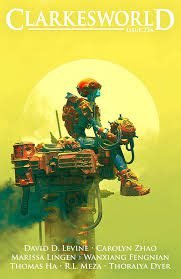
“Those Who Left History” is a multi-voiced speculative fiction told through interleaved diary entries, journalistic reportage, and future historiography. Its central conceit is “spatial closure” technology — a process by which a small, self-sustaining living space can be folded inward until it severs all interaction with the outside universe. Companies market these sealed units as “exclusive residences”: permanent, apocalypse-proof retreats for the wealthy and the desperate alike.
The story’s most intimate thread belongs to Zhou Xiaoliang, a man who made a sudden fortune on leveraged futures after nearly killing himself in poverty, walked into a dealership the same day, and signed a contract without hearing the sales pitch. His diary, spanning over a thousand years of outside time compressed into roughly sixty years of personal experience, forms the emotional spine of the narrative. The residence “skims time” like a stone across water, surfacing for a day or two every few years while decades pass outside. Zhou watches cities rebuilt, wars fought, androids appear, and humanity eventually migrate to other planets — all through a window he can observe but never open.
Woven around Zhou’s entries are segments from an investigative journalism series titled “Those Who Left History.” A former saleswoman, Li Xiaoqin, describes the psychological toll of targeting isolated, traumatized, wealthy individuals and shepherding them toward a permanent, irreversible disappearance. She preserved the contact information of clients’ families; through her leads, reporters document three case studies — a family that still dusts a son’s room monthly, a daughter who staged her own funeral and left an epitaph carved in stone beside her grandfather’s empty martyr’s tomb, and a rural father bitterly resentful that his son took a sudden fortune with him into the void.
A second journalistic thread follows Dmitri Petrovich, a soldier in Eastern Europe who lost a leg in war, was declared dead in error, and returned home to find his wife had entered an exclusive residence using her survivor benefits. He sets out to confront a broker with violent intent, but when the broker arrives — also missing a leg, on the opposite side — the two men simply talk. Petrovich orders a residence, then, on the operating table where his organs are to be harvested as payment, abruptly forfeits his deposit and walks away. He has found, through the brush with annihilation, his reason to stay alive.
The story’s final layer arrives far in the future, when a correspondent named Ha_Sidelobe4 joins a rescue excavation team returning to Earth and attempts to convince a joint government engineering committee to halt the physical dismantling of Earth’s cities — a process that will destroy the gravitational anchor points of any surviving exclusive residences, casting their occupants into permanent cosmic isolation. The committee argues that those who left history surrendered their rights by that choice; the correspondent counters that a nonexistence created by choice is still a form of existence, and that history cannot truly be erased — only driven underground to bleed from unspoken wounds. The hearing ends inconclusively, but the city is ultimately lowered back into place, and the correspondent joins strangers gathered around a bonfire at an ancient scorched pillar, telling a story to a presence perceived as a pair of sorrowful eyes in the sky.
Zhou’s final diary entry, written as Earth is being dismantled around him, captures the story’s central paradox: he made no history, belongs to no history, yet human history has been the entire fabric of his inner life. The story meditates on exile, memory, the ethics of abandonment, and the impossible question of whether those who flee the world can ever truly leave it — or whether the world, in turn, can ever truly let them go.
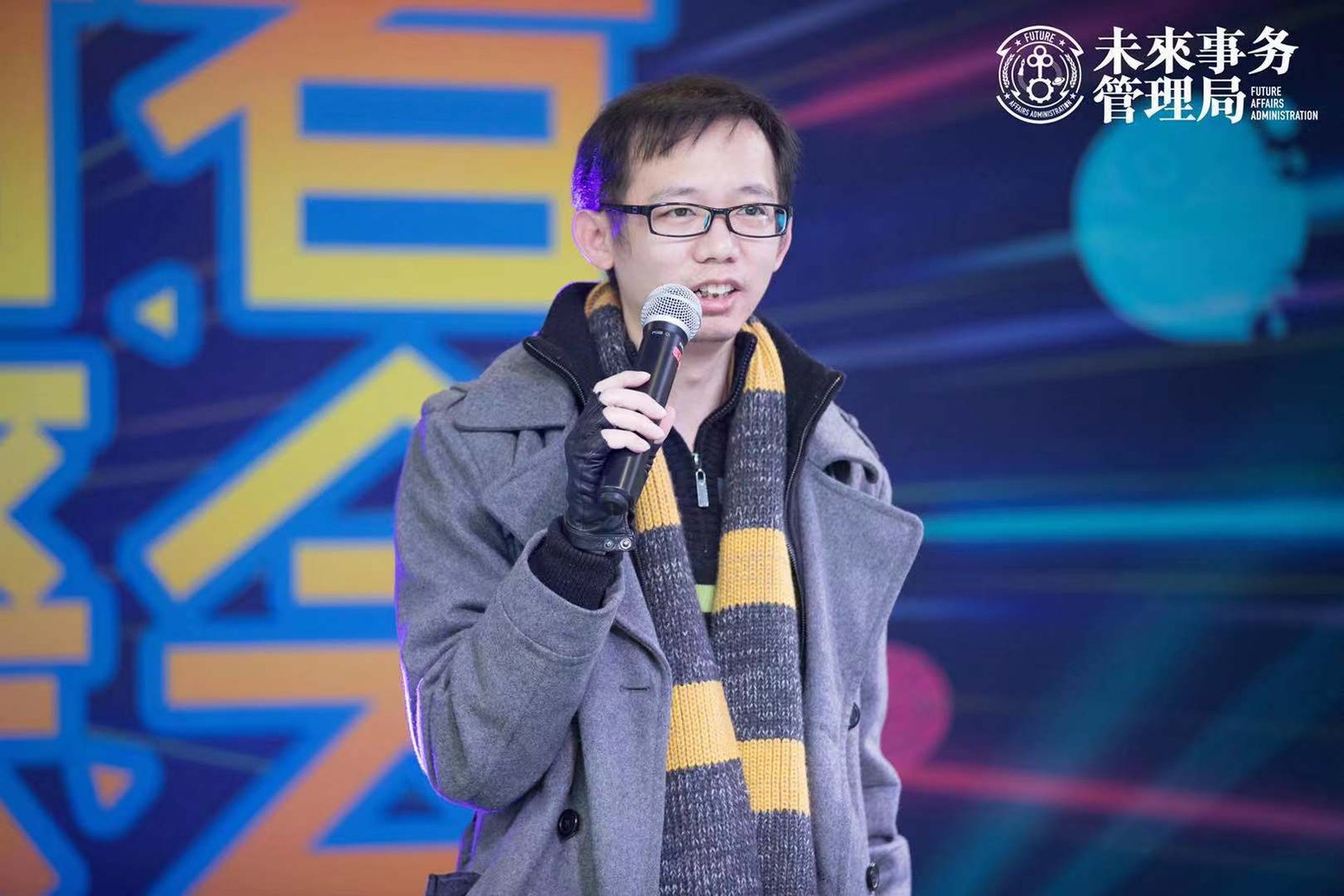
Wanxiang Fengnian, a science fiction writer renowned for intricate world-building and narratives that blend mixed reality, spectacle, and emotional depth. His works have been frequently selected for annual science fiction anthologies and translated into multiple languages. He have received various prestigious Chinese literary awards including the Galaxy Awards, Chinese Nebula Awards (Xingyun Awards for Global Chinese Science Fiction), Lenghu Awards. Published works include the personal anthologies A Mountain of Dust and The Ones Who Light Up Time.

Stella Jiayue Zhu is a translator, editor, and academic. She is interested in all questions concerning the nature of intention and reality. When not writing, she is a tutor at St. John’s College, Annapolis. She has a PhD in philosophy from the University of Notre Dame.