
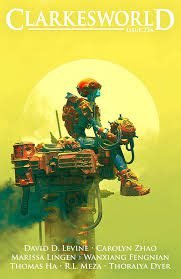
Clarkesworld, March 2026
Diona, a seventy-three-year-old woman living on a small Pacific island nation called the Republic of Ratak and Ralik, detects an unusually severe typhoon approaching. Using her notebook — a sophisticated handheld device that pulls real-time satellite data — she projects that the storm will destroy between 160 and 180 homes, along with all their supporting infrastructure: solar panels, gardens, water distillation units, and walkways. The islands themselves are already a shadow of what they once were, their land mass steadily eroded by rising seas, their structures perched on stilts above open water where solid ground used to be.
Diona and her friend Beroni convene a community council to coordinate a response. The islands are governed by the Four Principles established in a founding document called the Reconstitution — Interdependence, Adaptation, Cycling, and Succession — ratified in 2071 after a period of global crisis in which many nations fell to violent revolution. The Republic chose a different path, reorganizing itself around mutual aid and shared resources rather than competition. Every household contributes to the common good: solar power, desalinated water, food from shared gardens. During the council, Diona walks the threatened shoreline with her nine-year-old grandson Delson, using the moment to explain their history and the meaning of the Principles, while Delson pushes back with the impatient skepticism of a child who simply doesn’t want to share his bedroom with displaced strangers.
As the storm — now named Typhoon Cimaron — draws closer, the councils grow heated. Community members argue over competing priorities: protecting a beloved local store versus reinforcing a bridge that would cut off half the island if lost. Frustrated and exhausted, Diona steps outside and watches the palm trees whipping in the wind. She recalls how, during the earlier Typhoon Namtheun, rigid human-made structures were splintered and shattered while the palms bent, swayed, and survived. The memory triggers a realization: the community has been adapting in the same old ways, and what the moment demands is a new kind of adaptation entirely — what the Fourth Principle, Succession, actually calls for.
Returning to the meeting, Diona makes her case. The community abandons its strategy of shoring up vulnerable structures with riprap and plywood and instead focuses entirely on stripping the most at-risk buildings of their essential equipment — solar arrays, desalination units, data servers, hydroponics — and relocating everything to the sheltered lee side of the islands. The storm will be allowed to prune away what cannot be saved, and the community will rebuild around whatever remains. The idea crystallizes when Diona stumbles over Delson in the dark, finding him camped under the dining table — having voluntarily surrendered his room to strangers and brought only what he deemed truly important. The child’s instinctive triage illuminates the principle.
In the story’s final pages, Diona helps salvage the tiny cottage her late husband Robert built by hand decades ago, stripping its equipment before the storm takes the structure itself. She sends Delson ahead with her notebook — a cherished object worn smooth by years of use — and stays behind alone, sitting on the floor as the house shakes around her. The ending is elegiac and resolute: the two-by-fours may break, but the people of the islands will bend like the palm.

David D. Levine is the author of Andre Norton Nebula Award winning novel Arabella of Mars, sequels Arabella and the Battle of Venus and Arabella the Traitor of Mars, space-opera caper novel The Kuiper Belt Job, and over sixty SF and fantasy stories. His story “Tk’Tk’Tk” won the Hugo, and he has been shortlisted for awards including the Hugo, Nebula, Campbell, and Sturgeon. Stories have appeared in Asimov’s, Analog, Clarkesworld, F&SF, Tor.com, numer-ous Year’s Best anthologies, and his award-winning collection Space Magic.