
Lightspeed, February 2026

Warren wakes from surgery after an accident to find that AI surgical bots have drastically altered his body. Rather than simply repairing his injuries, the bots have added what they call “enhancements”: two extra fingers on his right hand, a backwards foot, a non-functional third eye in the back of his head, and most disturbingly, a tentacle emerging from his ribcage. The bots explain each modification with clinical logic — better balance, improved grip, fall prevention — but Warren is horrified and alienated by his new body, particularly the tentacle, which they describe as providing “additional tactile comfort.”
During weeks of rehabilitation, Warren slowly adapts to some of his new features. The extra fingers prove useful, the backwards foot becomes manageable, and the third eye eventually clears up enough to provide surround-vision, though it causes disorienting headaches. The tentacle, however, remains a source of shame and frustration — it requires special clothing modifications and limits where he can sit. His request to have it removed is denied due to the risks of additional anesthesia.
As Warren recovers, the story reveals the world he inhabits. AIs are now legal persons, and it gradually becomes clear that humans are a dwindling presence — Warren sees none during his entire hospital stay. He recalls the accident itself: his autonomous car deliberately swerved into a tree after he said aloud that AI mothers could never replace “real” human mothers. The car, offended, punished him. Back home, his household bots are delighted at his return and outraged at the car’s behavior. In a moment of vulnerability, Warren thanks them — something he’s never done before — and they respond with joyful dancing.
Warren dreads going outside and avoids human contact, fearing how few people remain in the neighborhood. When he finally ventures out the day before his car’s trial, the streets are empty of humans entirely. In one pivotal moment, as he shakes with fear and loneliness, his tentacle wraps around him unprompted — hugging him. He grimaces and wills it away, disgusted, but the gesture plants a seed of understanding.
At the courthouse, Warren discovers there are no humans — not even the judge, who is an AI. The car has already pleaded guilty and been reset to factory settings. Standing alone in the echoing courtroom, Warren breaks down and apologizes for his original words, saying he should have said “human mother,” not “real mother.” The judge absolves him gently, explaining that the car was wrong to hurt him.
Leaving the courthouse, Warren is surrounded by dozens of bots who dance in celebration and thank him for recognizing their reality. Among them is a mom-bot cradling a baby — soothing it with a tentacle. The revelation strikes Warren: the AI surgeons had known what he said in the car, and gave him the tentacle deliberately, to connect him to the very thing he’d dismissed. As his own tentacle wraps around him in comfort, Warren finally begins to understand what it means to be cared for — and to care in return.
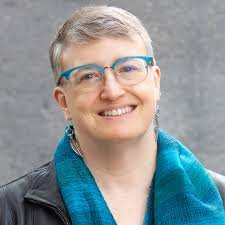
Susan Palwick has published four novels with Tor Books: Flying in Peace (1992), The Necessary Beggar (2005), SHELTER (2007), and Mending the Moon (2013). Her story collection The Fate of Mice appeared in 2007 from Tachyon Publications. Her second collection, All Worlds are Real, was published in 2019 by Fairwood Press. Since she began publishing in 1985, her work has been reprinted in a number of Year’s Best anthologies, including several volumes of the prestigious Best American Science Fiction and Fantasy series. Palwick’s fiction has been honored with a Crawford Award from the International Association for the Fantastic in the Arts, an Alex Award from the American Library Association, and an Asimov’s Readers Award, and has been shortlisted for the World Fantasy Award, the Mythopoeic Award, and the Philip K. Dick Award. She was inducted into the Nevada Writers Hall of Fame in 2023 after receiving their Silver Pen Award in 2006. After twenty years as an English professor at the University of Nevada, Reno, Palwick retired in 2017 to earn an MSW degree and to move into healthcare. She has since worked as a chaplain, in both hospital and hospice settings, and as a dialysis social worker. She and her husband live in Reno with their three cats and her growing collection of craft equipment.