
Radon, Issue 12, February 2026
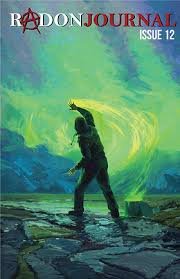
In a post-apocalyptic California choked with ash and emptied of nearly all human life, a deeply lonely and suicidal man named Jack rides his motorcycle to the headquarters of Aspect Corporation, a company that has advertised a solution to loneliness on the radio. Jack is candid with himself about his alternatives: riding off a cliff would be simpler, but he’s already made the drive, so he might as well go inside.
At Aspect Corporation, Jack is greeted by Raya, an exuberant, warmhearted receptionist who is clearly starved for human contact. He is then met by Dr. Raya Mizrahi — Raya’s more composed counterpart and, as it turns out, the entirety of the company’s staff. Dr. Mizrahi explains that Aspect Corporation’s technology scans a client’s brain and generates a companion — an “aspect” — drawn from a facet of the client’s own psyche. The doctor herself, for example, has externalized her love of talking (Raya the receptionist), her scientific mind (the technician Rafi), and her nurturing instinct (a gardening aspect). Jack agrees to the scan, pays with samples from his peach orchard, and waits.
Three days later, Dr. Mizrahi radios Jack with alarming news. Because Jack had not disclosed his active suicidal ideation, the process was “corrupted.” The dominant aspect of Jack’s psyche — his desire to kill himself — was what got externalized. His aspect has escaped and intends to murder him.
Jack initially receives this news with dark, gallows humor and settles in to wait for death. But as the hours pass, he begins to reconsider. He realizes he doesn’t want to be murdered, even if he has wanted to die. He grabs a survival pack and flees his home, only to encounter his aspect — a perfect physical mirror of himself — standing across the clearing. The aspect attacks, wounding Jack’s forearm before Jack escapes into the ruined city streets, eventually hiding in a locked storage space for the night.
The next morning, Jack radios Raya and asks her whether a person — or an aspect — can change. She tells him that change is inevitable and constant, sometimes sudden. Inspired, Jack resolves to confront his aspect rather than keep running. He returns home to find his aspect has been tending the greenhouse and has even nursed an injured fox kit back to health. Jack attacks, overpowers his aspect, and holds him at the point of death — only to find he cannot finish it.
Releasing his aspect, Jack has a revelation: Aspect Corporation gave him exactly what he needed. By externalizing his suicidal drive and forcing him to confront it, the process revealed that what he truly wants is not to die, but to stop wanting to die. He looks at his own unconscious face across the greenhouse floor and thinks: I don’t want to want to kill myself.
The story ends with Jack deciding to try something harder than either dying or killing — living with himself — and speaking that commitment aloud: “It’s not going to be easy. It might end horribly and violently. But I’ve got to at least try to live with myself.“
Evan Simon-Leack is a writer primarily recognized for his contributions to speculative fiction and literary journals. His work has appeared in various publications, including Radon Journal, where he contributed original fiction to Issue 12. Additionally, his writing has been noted in the context of professional science fiction and fantasy circles, such as the Science Fiction and Fantasy Writers Association (SFWA) reading lists. He is also associated with anthologies such as Mmeory.