
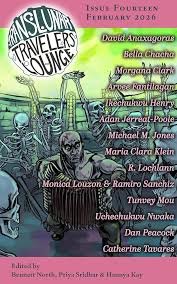
Translunar Travelers Lounge, Issue 14, February 2026
Chief Adewale is a seventy-two-year-old retired tailor in Ibadan, Nigeria, who has used a wheelchair since childhood after contracting polio. Despite his disability — and the quiet pity of his neighbors — he is anything but diminished. Every morning he races neighborhood children down Oke Bola slope in his battered, rust-scabbed chair, and wins. The chair is ugly and noisy, but Adewale refuses to replace it. Beneath the rust, faint golden swirls occasionally catch the light, though only he seems to notice.
Everything changes during a violent rainstorm when lightning strikes the mango tree in his compound and the chair begins to hover and glow. To the astonishment of Adewale and his sharp-tongued fourteen-year-old granddaughter Temi, the chair speaks — in the playful swagger of Ibadan Yoruba. It reveals itself to be no ordinary wheelchair but a forgotten throne belonging to a trickster spirit, a laughing, mischief-hungry deity who chose Adewale because he carried joy in a life the world had handed mostly sorrow.
What follows is a joyful reign of harmless chaos. Adewale cheats spectacularly at the neighborhood ayo board game. He crashes a corrupt politician’s rally at Mapo Hall, causing the politician’s empty promises to appear as glowing, parenthetical lies floating above his head for the whole crowd to read. The city dubs him the Rolling God. Children sing his name. Market women whisper it like a blessing.
But his fame attracts dangerous attention. Chief Kolapo, the humiliated politician, wants the throne for himself. He lures Temi — whose own taste for mischief makes her vulnerable — with fireworks, money, and honeyed promises of a spectacular prank. She takes the bait, and Kolapo’s men use bought incantations to seize the chair, throwing Temi aside. Seated on the stolen throne, Kolapo unleashes spirits of greed upon Ibadan. Markets are swallowed by soulless malls, hawkers replaced by holograms, the smell of roasted plantain smothered by plastic. The city mutates into a glittering, joyless paradise.
Adewale, now just an old man again in a borrowed chair, faces the return of pity and irrelevance. But he refuses despair. When Temi collapses in guilt, he holds her hand and reminds her that the throne chose them not for strength or wealth, but because they refused to let sorrow consume their laughter.
The resistance that follows is built not on force but on mischief: painted slogans, chickens released in banks, a blind griot’s scathing songs, a deaf drummer’s thundering rhythms, disabled and marginalized people united in joyful defiance. On festival day, Adewale leads a carnival procession to Mapo Hall and faces Kolapo directly. He defeats the greed-spirits not with weapons but with riddles, and Temi finishes Kolapo off with an explosion of pounded-yam flour and firecrackers that reduces the golden tyrant to a sweating, powerless man in a stained agbada.
Crucially, Adewale does not reclaim the throne for himself. He invites the city to sit on it — the griot, the deaf drummer, the aunties and children — until Kolapo is simply laughed out of power. The neon bleeds from the sky, the mango trees return, and Ibadan exhales.
The throne’s final form is its truest: not one man’s chariot, but a spirit that appears whenever anyone chooses joy over despair. The story closes with Adewale and Temi racing downhill side by side, wheels sparking gold, the city cheering them on — a reminder that in Ibadan, joy never retires. It only rolls forward.

Bella Chacha is a Nigerian writer whose works have appeared in Brittle Paper, IHRAM Publishes, Channel Magazine, Incensepunk, Cosmic Daffodil Journal, and many more. She was runner-up in the Defenestrationism.net 2025 Short Story Contest.