
Nightmare Magazine, August 2025
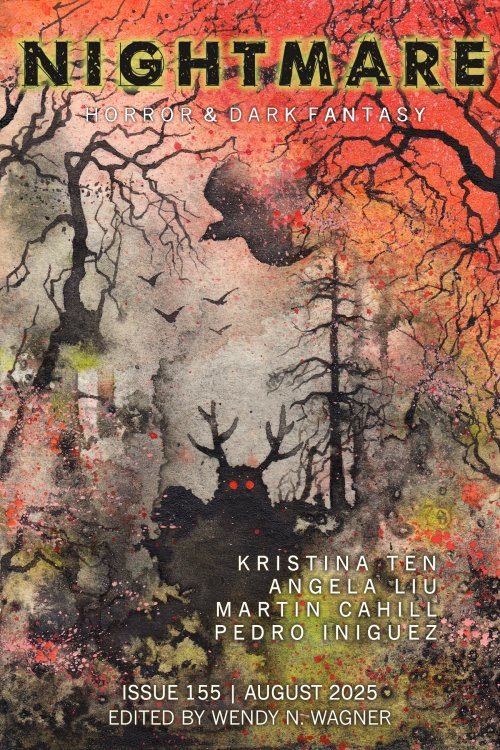
Hannah Gessen, a thirteen-year-old only child, arrives at Colden Hills Music Camp feeling out of place and unwanted. The camp is poorly maintained, mosquito-infested, and surprisingly devoid of actual music instruction. Hannah struggles to connect with the other campers, painfully aware of her social awkwardness and tomboyish appearance that disappoints her parents.
On the first night, Hannah overhears Ben, a veteran camper, telling the story of the “bunny-ear kids”—children abandoned by their parents at camp who went feral in the nearby woods. According to legend, these kids created a uniform by sewing animal parts onto their heads as “bunny ears,” eventually graduating to human fingers scavenged from a nearby cemetery. The bunny-ear symbol, initially just a playful photo gesture, became a warning: they multiply.
Hannah dismisses the story as typical camp mythology until she notices strange symptoms. Mosquito bites on her forehead swell into prominent bumps positioned exactly where bunny ears would sprout. She begins experiencing vivid nightmares and finding scratches on her body. Meanwhile, Hannah grapples with deeper anxieties about her parents’ love. She recalls overhearing them discuss how much she resembles her dead brother, who died at thirteen. She realizes they may have sent her to camp not for fun, but to be rid of her—a suspicion reinforced when no letters or money arrive from home.
During a rainy day of decoration-making, another camper accidentally smashes Hannah’s fingers with a hammer. The nails quickly blacken and fall off, revealing necrotic tissue underneath. Hannah’s transformation accelerates. She becomes convinced her parents abandoned her, just like the bunny-ear kids’ parents did. The psychological and physical changes blur together as Hannah loses her grip on reality.
On the final Friday, Hannah sneaks away from field day activities to Dogwood cabin. Using fishing line and pliers from the tackle box, she attempts to remove her damaged fingers to create her first pair of “bunny ears.” In a clearing near the lake, she encounters the bunny-ear kids—they’re real. A boy with rotting teeth and ears made from animal parts helps her complete the amputation using a fork to twist off the bone.
When two Dogwood campers, Olivia and Yume, discover the scene, Yume flees in horror. Olivia, a veteran camper used to elaborate pranks, initially mistakes the gruesome tableau for another camp joke. Hannah, now fully transformed and feral, attacks Olivia with the other bunny-ear kids’ assistance, harvesting her body parts to create more “bunny ears.”
The story concludes with Hannah achieving a twisted sense of belonging—finally part of a family, distinct yet unified, made whole through their shared mutilation and abandonment. The bunny-ear kids continue their cycle, multiplying as the legend promised, adding new members to their feral collective.
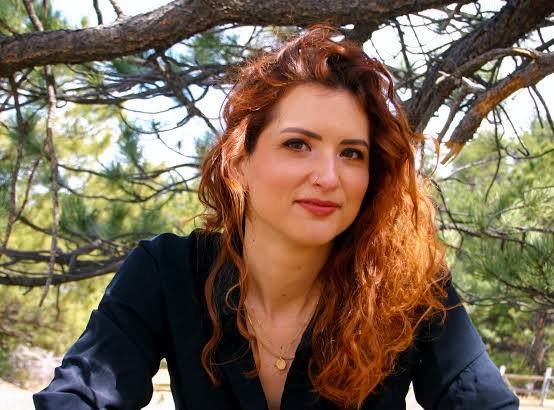
Kristina Ten has written about lovers experiencing erosion, demigods attending desert music festivals, spirits lurking in the backs of bathhouses, and seals granting wishes at the bottom of Lake Baikal. Her stories appear in McSweeney’s, Best American Science Fiction and Fantasy, We’re Here: The Best Queer Speculative Fiction, Lightspeed, Nightmare, Uncanny, and elsewhere. She has won the McSweeney’s Stephen Dixon Award, the Subjective Chaos Kind of Award for Short Fiction, and the F(r)iction Writing Contest, and has been a finalist for the Shirley Jackson Award, the Locus Award, and the WSFA Small Press Award.